


May 17, 2017
50 facts about Jerusalem
Fifty fascinating facts about Jerusalem — its history, culture, religion, and modern life — in honor of Yom Yerushalayim and the city's Jubilee Year.


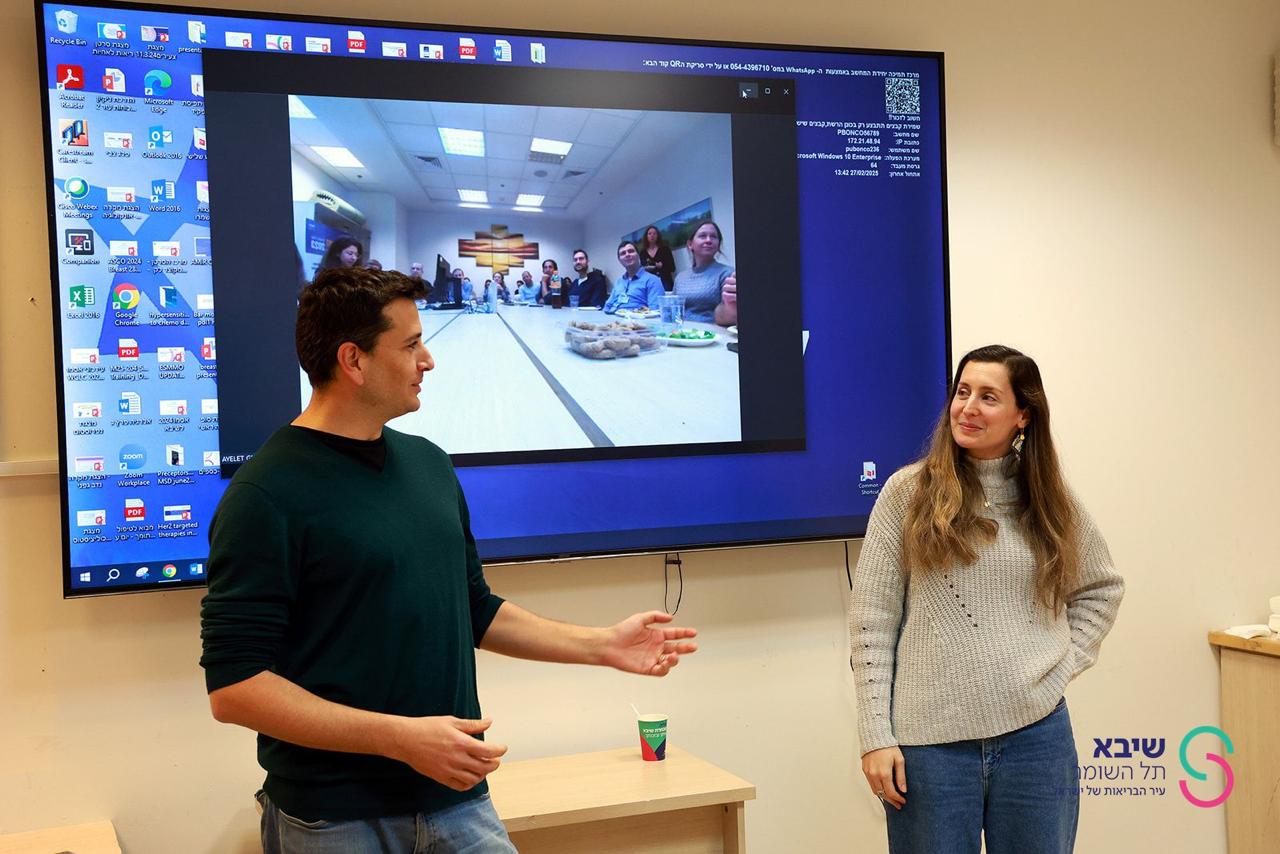

Through CJP’s Boston-Israel Fund, Tech4Cancer recently received a seed grant to advance its work at the intersection of technology and cancer care. By investing in Israel’s robust technology and research ecosystem, CJP is supporting the people working to turn promising ideas into practical solutions that address complex challenges and have the potential to benefit patients, families, and institutions far beyond Israel. During Breast Cancer Awareness Month, Tech4Cancer’s story highlights the innovation and collaboration driving new possibilities in the fight against cancer.
By tapping into Israel’s robust technology and research ecosystem, these grants support efforts to address complex challenges, advance collaboration, and develop approaches with the potential to benefit people and institutions far beyond Israel.
Cancer changed Gal Avital’s life twice. First, she was diagnosed with triple-negative breast cancer after the birth of her eldest son. Then, about a month after the birth of her twin daughters, she received the same diagnosis again.
Both times, Gal and her husband, Idan, were building their family while facing uncertainty about their future together. What Gal wanted was simple: to be there as her children grew up.
That experience changed how they thought about cancer, medical research, and the ways they could help other families facing the same uncertainty. Drawing on their professional backgrounds and connections, they began looking for practical ways to make a difference.
Today, through Tech4Cancer, they are bringing together Israel’s technology professionals and cancer researchers to help solve problems that can otherwise slow scientific progress. With support from Combined Jewish Philanthropies (CJP), they are working to turn technical expertise into practical tools that help researchers move their work forward.
Gal and Idan’s work began with the challenges patients face outside the treatment room.
During one of Gal’s treatments, Idan sat beside her trying to resolve an issue with the Israel Tax Authority after a submitted form could not be found. They thought about other patients navigating the same bureaucracy without someone to help them—or without the energy to keep pushing through the process.
That experience led them to establish Green Wave with HalaSartan, helping cancer patients submit forms and access benefits more easily. By August 2026, more than 7,400 forms had been completed through the service.
They later co-founded HalasTech with HalaSartan and technology companies, including Microsoft, Google, Meta, Lightricks, McCann Digital, Wix, and Fiverr. The initiative helps self-employed cancer patients and survivors rebuild businesses affected by illness, using professional expertise and technology to support financial independence and self-worth.
These experiences showed Gal and Idan that people could use their professional skills to address real challenges created by cancer. Tech4Cancer takes that idea one step further: bringing those skills directly into cancer research.
Cancer researchers often work with complex scientific questions and valuable data, but may not have immediate access to the software development, image analysis, or artificial intelligence expertise needed to advance their work.
Tech4Cancer helps bridge that gap.
The organization connects researchers and physicians with technology professionals who work alongside them over several months. Together, they identify a specific research challenge, assemble a team with the right skills, and develop and test a solution in collaboration with the laboratory.
The researchers lead the science. Volunteers contribute their technical knowledge, whether in software development, machine learning, data analysis, product design, or project management.
The goal is not simply to make introductions. It is to help turn a research need into a tool that scientists can actually use.
At Sheba Medical Center, Dr. Dana Ishay-Ronen’s laboratory needed a more efficient way to analyze images of organoids, three-dimensional models used to study breast cancer tumors.
Manual analysis was time-consuming and could take an estimated one to two years to complete. Tech4Cancer volunteers Amir Zait and Tal Rimon Edelstein developed a deep-learning workflow to identify cells and extract measurements from the images, reducing the burden of manual analysis.
Their contributions were acknowledged in a research paper published in Frontiers in Oncology.
The project offers a concrete example of what can happen when technical expertise meets a specific scientific need: researchers gain tools that can make complex analysis more manageable and help them move their work forward.
For many Tech4Cancer volunteers, the work is personal.
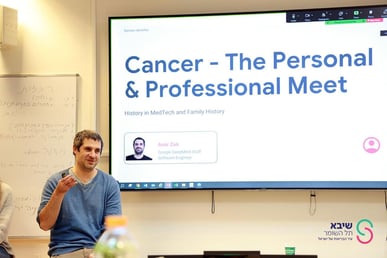
Amir, a machine-learning specialist at Google who previously worked at a medical startup, joined after a volunteer opportunity circulated at his company. His family’s history of cancer helped motivate him. Working directly with researchers and visiting the laboratories at Sheba made the experience especially meaningful.
Another volunteer, Ayelet Yotvat, came to Tech4Cancer with her own experience of loss. Her husband, Erez, was diagnosed with pancreatic cancer about a month after their youngest son was born. He died in 2015, a year after his diagnosis. Erez had himself led a team developing a device for the early detection of colorectal cancer.
Ayelet wanted to find a way to combine her professional experience managing technology projects with meaningful volunteer work. Today, she serves as a project manager on a collaboration involving Tech4Cancer, Sheba, and Clalit, which is developing a model to explore earlier detection of pancreatic cancer using research data.
The team has obtained access to datasets and is working on the model. It remains in development and has not yet been validated as an early-detection tool.
For Ayelet, the opportunity is a way to put her experience to work for other families facing the uncertainty her own family knew so well.
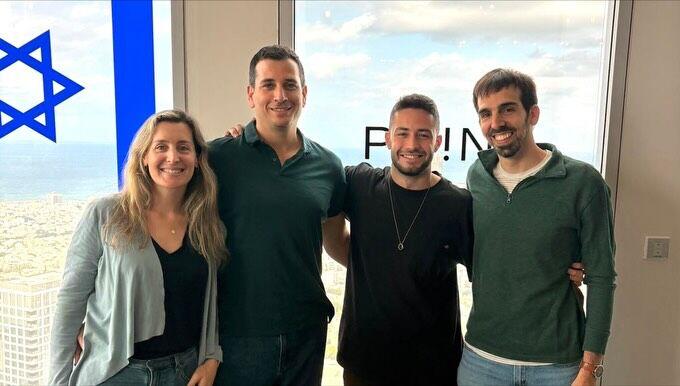 As of September 2026, Tech4Cancer’s network included approximately 170 technology professionals, around 100 of whom were active. The organization was supporting 26 ongoing projects involving more than 40 researchers and physicians, with volunteers bringing experience from companies including Google, Microsoft, Amazon, Salesforce, Wix, and others.
The work extends beyond individual research projects. At Sheba, volunteers are helping analyze blood test results from 168 pancreatic cancer patients to investigate patterns associated with treatment resistance. At the Hebrew University of Jerusalem, a team developed an interface for researchers to explore data from synthetic genetic circuits.
Tech4Cancer is also developing tools intended to support multiple research teams. With Base44, the organization is building a map of Israel’s oncology ecosystem to help identify researchers, studies, expertise, data sources, and opportunities for collaboration. Another initiative aims to develop a multi-center breast cancer registry with researchers at Hadassah.
These initiatives are still in development, but they reflect a larger ambition: to make it easier for researchers to find the expertise, information, and tools they need.
Through CJP’s Boston-Israel Fund, Tech4Cancer recently received a seed grant to advance its work at the intersection of technology and cancer care. As a newly CJP-supported organization, Tech4Cancer reflects CJP’s commitment to backing innovative solutions with the potential for meaningful impact. Its story is especially timely during Breast Cancer Awareness Month, offering a look at the people working to bring new possibilities to cancer research and care.
CJP’s support is helping Tech4Cancer sustain its work, coordinate researchers and volunteers, develop shared tools, and explore solutions that could benefit multiple institutions.
For CJP, investing in organizations like Tech4Cancer means supporting people who are building new approaches to complex challenges. It is an investment in the infrastructure, expertise, and collaboration that can help promising ideas advance—not a promise of an immediate medical breakthrough, but a practical way to help researchers do their work.
For Gal and Idan, the motivation remains deeply personal. Cancer affects more than the person diagnosed. It changes families, working lives, and plans for the future.
They cannot control every outcome. But they can bring people together, put their skills to work, and help researchers pursue the next question, test the next idea, or develop the next tool.
And behind all of that work is a hope that more families will have something Gal wanted from the beginning: more time together.
Learn more about CJP’s work in Israel and the organizations helping build solutions for the future at CJP.org.